Posts

The Duchess and The Printer
Image
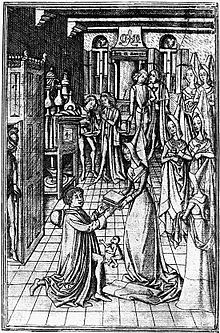
  William Caxton offering the first book ever printed in English to his patron Margaret of York This year marks the 550th anniversary of the first-ever printed book in English. A worthy topic for a writer's blog, I think! Last night, I spoke at my Book Club who, having just read The Personal Librarian , chose to read my Daughter of York, when I explained that William Caxton (the "printer" of my blog title) was a major character in it. Thus the members could enjoy the connection between J.P. Morgan's obsession to obtain a certain Caxton-printed book for his NY library and how that book came to be. The"duchess" of my title is, if you hadn't guessed, Margaret of York , the protagonist in my second book. It was a longer book than the usual choice of our club, but not as long as the Stephen King one of a few months ago, which I confess I did not get through. (In my old age, I have only minimum patience for books I have no interest in reading--even for a b...

Goodreads Giveaway!

Image
  Trying to walk the fine line between making the writing of a book into at least a break-even proposition in this day and age of publishing nightmares, my Marketing Manager (Scott!) felt giving away 50 e-books  of This Son of York on Goodreads might generate interest (and a few sales!) and coincide nicely with The Lost King  movie's release. (Have you seen it yet??) The Giveaway lasts all month, so I invite you to take advantage and sign up!

Saw it in a Wheelchair!

Image
 I finally got to see The Lost King this week! Having taken a fall last week, broken bones in my right foot and sprained/strained the other knee, I had to be pushed into the movie theater in Port Charlotte by my long-suffering husband, Scott. In the interests of full disclosure, I did see the film in January at a friend's house who had managed to stream it with an unlocked thingamajig, but sitting in her sunny apartment living room with me answering her questions as we went along, it was not the same as actually SEEING it. On the big screen. In the dark. With an audience. And with surround-sound!  I was transported back a decade to the thrilling announcement that an archeological dig in a car park in Leicester had actually uncovered what they thought were Richard III's remains. Six months later the DNA confirmed it. Steve Coogan and Jeff Pope (who also teamed to write Philomena) were obviously intrigued enough to think this amazing and historic discovery by a middle-aged, S...

Missing Princes Project

Image
  Philippa Langley with Harry Lloyd, who plays Richard III in The Lost King In the middle of composing a blog about "Who Killed the Princes in the Tower," I received an email from Philippa Langley, she of the amazing discovery of Richard III's bones under the Leicester car park. It was perfect timing!  In the interests of full disclosure, I became acquainted via email with Philippa back in 2011, when I sent money to her Finding Richard project. In 2013, when I started writing Richard's story in This Son of York , I asked Philippa's permission to use several of her passages from the book she co-wrote with Michael K. Jones, The King's Grave , and she graciously gave me permission. Philippa is as humble about her historic search as Sally Hawkins  portrays her in the new film The Lost King . Not satisfied with spending years following her dream to unearth the last Plantagenet king of England, she has spent the last six years delving into "what happened to th...

O, those darling Little Princes!

Image
         J ust look at these paintings! Doesn’t your heart break for these brothers, “imprisoned” in the Tower of London and unaware of their fate? One of the paintings (Victorian, granted) shows the “murderers” hovering over those adorable boys.      What really happened to them? After July 1483, they were never seen again — or were they? This is probably the most intriguing mystery of English history after who was Jack the Ripper. It has gripped me for most of my adult life, too.      All I know, in my heart of hearts, is that Richard III was not the killer, although history loves to say he was!      So who were they, and why were they important? Edward, 13, and Richard, 11, were the only sons of King Edward IV and when Edward died suddenly at age 42, young Edward--I'll call him Ned to avoid confusion with his Dad--was named (but not crowned) King Edward V. In medieval times, it was never  a good idea to have ...

Richard III as a Good Guy

Image
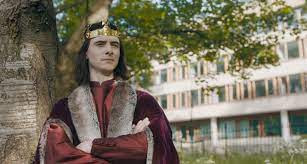
I was pleased to see, for a change, that The Lost King movie chose a nice-looking, undeformed young actor named Harry Lloyd to play the fantasy Richard. And he was downright pleasant throughout, unlike the character in the famous Shakespeare play! Harry Lloyd as Richard III Anyone who has read or seen Richard III  should know that our Will played hard and fast with the historical record. Such a brilliant play with an enviable lead for an actor, but oh so wrong in many ways. For example, there's the hunchback bit, which I covered in last week's blog. It was scoliosis--sideways curvature, not kyphosis--hunchbacked. Then there were the murders attributed to him on his way to "usurping" the throne--even that of Edmund Beaufort, duke of Somerset, who actually died in the first Battle of St. Albans when Richard was only three! How's that for a skilled toddler-warrior?  And his inappropriate, sleazy seduction of Anne Neville at the funeral of her husband, Edward, prince...

Richard III's Bones

Image
  Richard III's skeleton Was Richard really a hunchback? I get that question over and over during my book tours, and up until 2012, my answer was enigmatic. "We don't know," wasn't satisfactory, I know, but being a writer meticulous about accuracy, I chose not to even refer much to his physicality in all my books--except the last one, This Son of York.  I needed to write the final book in my series about Richard's family precisely so I could now set the record straight and answer the question truthfully. It added to his story immeasurably. No, he was not a hunchback: he had a bad case of scoliosis that developed gradually only during his teen years, which is very different from kyphosis (hunchback).   With the discovery of his skeleton under that car park in Leicester, the dreaded words "crooked spine" were used to describe what the osteologist saw in the makeshift grave. "Oh no," I thought, "and I haven't mentioned his back in any...