Posts

Dem bones!

Image
Medieval bones found during renovations at the Tower of London recently. I found this new story really interesting pertaining to another medieval-bones discovery at the Tower... This discovery reminded me of the more famous unearthing of the alleged bones of the two young princes, who disappeared in Richard III's time, by workmen doing renovations at the Tower of London in the 1660s. So the story goes, the workers threw them in a heap with other rubbish but reported the finding to a higher up, who wondered if perhaps these were the bones of those princes and so retrieved them. Why would he have assumed they might be the princes' remains, you ask? Here's where Tudor propaganda once again comes to the fore. Sir Thomas More, writing at the court of Henry VIII, wrote "The Historie of King Richard III," a damning book about Richard, used by Shakespeare as one of his sources, in which More describes the princes' deaths by murderers sent by Richard: ...

GUEST BLOG WITH AUTHOR "MEDICI'S DAUGHTER" AUTHOR SOPHIE PERINOT

Image
I am so pleased to have been asked to share my thoughts about This Son of York with my friend and fellow historical-fiction author Sophie Perinot. If you haven't read her book Medici's Daughter about Marguerite of Valois (Queen Margot), then you are missing out! Sophie is a fabulous writer and has spent a weekend at our house when she was a panelist at the Newburyport Literary Festival. Her latest collaboration is Ribbons of Scarlet about the French Revolution with five other authors. I'm in the middle of it and am learning A LOT! Thanks again for hosting me on your blog , Sophie!

Research Reminiscences

Image
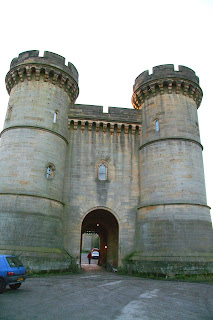
The gatehouse of Brancepeth Castle, Co. Durham Most of my on-the-ground research has been in England and Belgium, and I pride myself that I have pretty much explored everywhere my characters would have walked, although not all the venues look the same as they did in the 15th century. Two incidents—one serendipitous and one funny—come to mind when I look back on nearly 20 years of traveling for research. In Mechelen, Belgium (Malines, Burgundy in Margaret of York’s time), my travel companion Maryann and I were traipsing around the town, she taking photos and I scribbling descriptions, making our way to one of Margaret’s principal residences. I knew it was now used as a theater but I really wanted to go inside and see if I felt any Margaret vibes. It was shut up tight, and I groaned. Undaunted, I circled the building and saw a modern, glassed-in staircase tacked on the back. Before Maryann could stop me, I tried the door, found it open and marched up the stairs, no knowing where ...

Open Day at Bosworth Battlefield Center...

Image
I have been to the Bosworth Battlefield Center three times, and each time I am impressed by the changes that have been made. When I was there in 2017 on my pilgrimage to my homeland to see Richard's grave and new tomb in Leicester, I was welcomed by the staff at Bosworth as a member of the Richard III Society and given the royal treatment. There is much to see and experience (photos below), and I will never forget being able to use an electric wheelchair (due to an ankle injury) and turn up the speed going down the same hill they think Richard charged down! My poor husband must have felt as helpless as Richard's closest friends did as they watched him suddenly take off down the hill to engage directly at Henry of Richmond. Scott was able to head me off before I turned the cart over, however, and crisis was averted. Not so for Richard, who, as we know, lost first his horse and then his life on Bosworth field on August 22nd, 1485. He was the last English king to die in battle. ...

Medieval ideas of love and marriage

Image
“Love and marriage, love and marriage, they go together like a horse and carriage” ...well, not so much in medieval times! Margaret of York, Richard III and Edward IV’s sister, was promised to half a dozen men before her brother Edward finally gave her to a brute of a man, Charles the Bold, duke of Burgundy. And she never met any of the gentlemen and only met Charles a couple of days before their formal betrothal in Damme, near Bruges, in 1478 when she was the ripe old age of 22. For Edward it was a political win; for Margaret it meant leaving her family and her homeland for ever (well, except for a three-month visit back to England in 1480 to negotiate trade agreements for her new country) and being saddled with a man without scruples and very few morals. Sometimes--in the case of King Henry VI and Margaret of Anjou--one or other had someone stand proxy for them and you might be married before you even saw your husband! Imagine dreaming about your knight in shining armor or you...

"Royal Mistress" makes her entrance!

Rather than me blathering on about Jane Shore, I thought she ought to speak for herself on this 7th day of May when the world will read her story in "Royal Mistress" perhaps for the first time. We chatted recently and here is some of that conversation. AES: How would you describe yourself? JANE:   Much too short, unfortunately. I wish I had some of your inches! I’m told I am pretty, and I know my sister envied my blonde hair, but I think my breasts are too big (can I talk about that or is it impolite--not that I particularly care about that sort of thing) and my neck isn’t long enough for the gorgeous necklaces Edward used to hang on it. I do like the color of my eyes, though. It is very changeable and it gives men a really hard time when they are asked to describe it. They are sea-green--and you know how many different colors the sea can turn. AES: Do you hear that you are supposed to be Edward’s merriest of mistresses? JANE: Ha! Is that what they say? Well, then, let me...

To err is human...

... (If I may quote a different Pope from the one in the news recently!) Historical novelists who don't like to mess with history dread being caught out with a glaring error. So far, I've been pretty lucky that my books have passed muster for the most part. A musician friend pointed out that "base" was not the correct spelling for a string on a musical instrument in A ROSE FOR THE CROWN, and that as a former folksinger and guitarist, I should have known how to spell "bass." In the same book, a Richard III Society member (and they are a terrifyingly knowledgeable group to write for!) pointed out that I had the wrong bishopric for Lionel Woodville (I had it right the first time I mentioned him, I hastily add!). Happily, these were found early after publication and subsequent editions of the book were corrected. But those slips were nothing compared with the one caught by the book reviewer in the latest edition of the US Richard III Society's magazine, R...